Covid-19

Blogs

Corona virus, UK Mosques and Financial impact

Mosques in UK play a vital role for the Muslim community. They open every day for the five daily prayers and for the evening school. They hold large gatherings of worship every Friday and every night of Ramadan. Many large Mosques provide funeral and wedding services. Due to Government advice, Mosques across the UK have closed. Ramadan this year will fall during the lockdown which normally is the busiest period for Mosques. This Ramadan, they will fall silent with doors shut to thousands of worshippers that flocked to them every day and night – this is a devastating loss to those who planned to visit their local Mosque during this Ramadan. The spiritual loss of collective worship is clear but with this there is also a significant income drop that these Mosques now face. Friday collections, evening school fees and special donations raised during the month of Ramadan are all in jeopardy. Mosques are free with no entry fees; all donations are voluntary, and these donations are used to fund the daily running costs of the Mosques. Their closure means their access to cash and donations has suddenly stopped. The impact in numbers Friday collections and evening schools’ fees make around 75% of the total yearly income of the Mosques. In large Mosques, this part is still significant being around at least 50% of the yearly income. A three-month closure of the Mosque will drop the yearly income by at least 20% and this is without the Ramadan donation effect. The closure during Ramadan will eat away a big opportunity to raise funds – often for Mosque expansions. The payroll costs of Mosques represent around 50% of the total yearly costs with some staff on self employed contracts. The true staff cost (payroll plus self-employed) could reach up to 75% of the total yearly costs. During the closure, there are some costs Mosques will save but I don’t expect this to be significant. We are in summer months so gas and electricity usage will not be high. The closure has stopped the income leaving Mosques with costs to bear. The Government Job retention scheme will fund 80% of the salaries, bearing in mind that a vast majority of Mosque employees are either on national minimum wage or not far from it. The Government is yet to set up a portal for the claims and once set up there may be delays before the money hits the Mosque bank account. This will pose a cashflow challenge. Action plan In these challenges time, the following are some of the actions Mosques should consider: Payroll: Continue processing the payroll for furloughed employees even if you don’t have the cash to pay the employees. The Government will compensate 80%, back dating to 1 March 2020. If the employees are not on the payroll then there is no compensation. I expect the Government to extend the period of this scheme if the situation does not improve. Self Employed: There is no support from Government to fund Mosques for the self-employed who provide services to the Mosque – The Mosque may be able to immediately stop their service or reduce their payments. If the Self Employed are depended on the Mosque income and there declared income is not enough then they should apply for Universal Credit. Online: Switch to online solutions for teaching children to compensate the evening school income. This is a sudden requirement and many Mosque staff may not be trained or tech savvy. National member organisations (I.e. MCB, MINAB) should urgently set up working groups or platforms that can provide volunteers, guidance or vet suppliers that Mosques may choose to provide this service. Databases: Those Mosques that had created donor databases should use this database to encourage donors to set up monthly or weekly direct debits, focusing on Friday collections and sadqa. Those Mosques that do not have a donor database, they should immediately start compiling one. The lock down may continue for a longer period if the NHS capacity is breached or not controlled as expected by Government. Mosques must act now and not assume this will be over soon. Ramadan: Develop fund raising campaigns for Ramadan that may involve social media (Facebook, YouTube channels) and donation boxes at homes of regular worshippers. Restricted funds: Majority of the Mosques don’t have restricted funds given the nature of the general use of Mosques by worshippers. If a Mosque does hold restricted funds, these are for either Mosque construction or for various International appeals focused on poverty. Restricted funds can only be spent on the purpose they were given for. However, the Charity Commission has released guidance on using restricted funds to fund or cope with an unexpected event like the one unfolding at present – this should be the last resort and the Commission has encouraged taking professional advice. Qard-e-hassan: Raise qard-e-hassan to cope with the closures – Unlike many other businesses, Mosques have a sustainable business model. As soon as the lock down is over and Friday prayers and evening schools start – the cash generation will start immediately. Mosques will always have a mechanism to pay back the raised qard-e-hassan, same may take longer as a result of this crisis. Reduce costs: The impact of a three-month closure of Mosques and Business will have a financial impact that will last for years to come. This is the time when Mosques should start to streamline their costs and explore long term savings that can be made. Once the lock down is over, it is most likely the donors will have less to donate. This may impact many of the planned Mosque expansion projects and the funding of ongoing costs. and Financial impact
Uncategorized

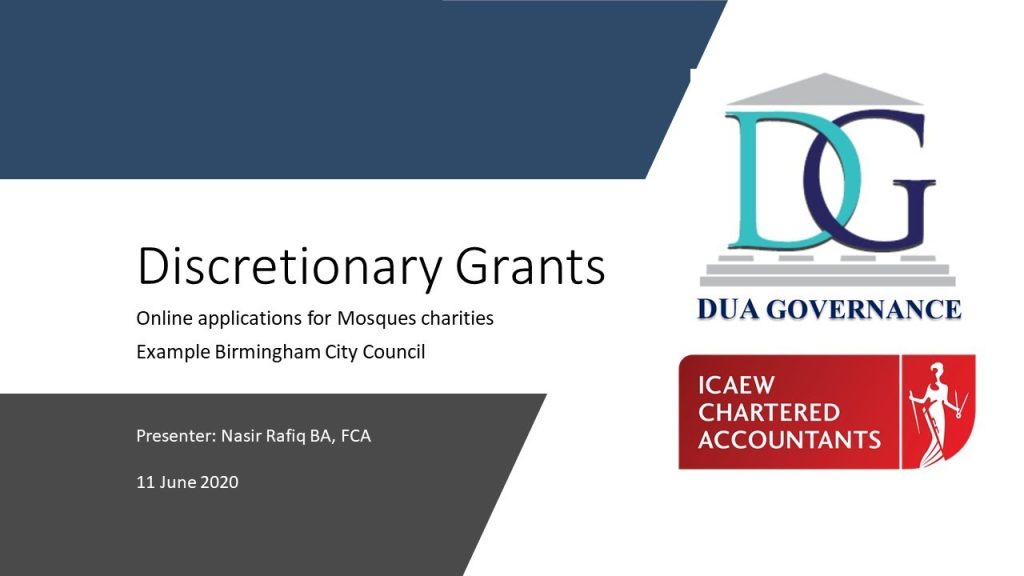
Webinar: Discretionary Grants Online application

  In this webinar hosted by Waqar Altaf, (Governance Manager), Nasir Rafiq talks through the online application process for discretionary grants at Birmingham City Council. He focuses on Mosque charities and on the expected general approach of Councils.   Webinar Speaker Nasir Rafiq BA, FCA (@Dua Governance) Nasir Rafiq is a widely experienced Chartered Accountant and a Charity Financial Governance Expert. He is the Founder and Director of Dua Governance – a professional firm that provides a wide range of accountancy and advisory services to many charities (www.duagovernance.com).   During the lock-down crisis, Nasir has been helping Mosques and charities by writing blogs at www.duathoughts.com and by holding webinars. Recently and on behalf on many Mosques he has now engaged Birmingham City Council to address specific concerns they have around grants.

Uncategorized

Unity FM Radio: Local Councils approach for making Covid19 support grants to Mosques

  Lockdown Special Edition 4th June 2020, 5:30pm Unity FM presenter Ahmed Bostan talks to Nasir Rafiq (Chartered Accountant and Charity Finance Expert) about Birmingham City Councils approach towards Mosques in relation to Covid19 support grants. The current approach of the Council is making it hard for Mosques to apply despite being heavily financially effected by the lock down.

Uncategorized

Covid19 – Abysmal Government support to UK Mosques

Mosques are hard hit during the Covid19 lockdown crisis. All Mosques across all sects and cities adhered to the Government guidance immediately and shut their doors to daily worship. This was a difficult and painful decision for Mosque management, daily and Friday worshipers and for parents who sent their school children to study Quran every evening in the Mosque. This pain was aggravated as the busiest period for Mosques, the holy month of Ramadan fell in this period. Govt support has done little to bridge the gap Underlying the spiritual deprivation was the financial costs, as around 75% of Mosques income relied upon the donations collected each Friday, education fees and special donations raised during the month of Ramadan – unfortunately, the Govt support has done little to bridge the gap. Furlough scheme – not fit for purpose The only meaningful Govt support has been the job retention scheme which required to furlough staff, meaning sending staff on leave. This was difficult for Mosques to utilise as the paid Imam position is crucial for fundraising, not just for leading the prayers and delivering sermons. This also created a situation where an Imam who is not able to do his job properly and fully, however because of online sermons (religious obligation) technically does not qualify for the job retention scheme. Misjudged guidance on volunteering The Governments advise on placing restrictions on volunteers misjudged the importance and the role of volunteers within the faith sector specifically – much of the volunteering is driven by spiritual reasons which followers of the faith consider obligatory on themselves. Placing restrictions on volunteering within the business sector made sense, however the faith sector should have been exempt to it. Last hope – Council grants did not work After the Job retention scheme, the Mosques hoped to apply for the coronavirus grant from the local council as the business loans options was not considered suitable or viable for Mosques. All Mosques operate from buildings and due to Government advise these buildings were closed immediately to the public. The Government had decided to use the local council business rates system and the date of 11th March 2020 to issue grants using rateable value (RV) and the awarded discounts under two schemes, mainly the small business discount and the expanded retail discount. In my view this was a sensible approach, however as it turns out, this discriminated against charities that did not have retail or trading operations, despite operating from a building and being subject to similar levels of business rate discounts similar to businesses. Government guidance and its interpretation Government guidance for Coronavirus RHL Grant Fund dated 1 April 2020 under the section ‘Properties covered by the fund’ stated that Eligible charities which have received charitable rate relief or discretionary relief can still get the grant. Local councils interpreted this guidance only relevant to charities with trading operations. This is despite the published Government guidance not explicitly excluding charities without trading operations in the guidance dated 1 April 2020. Many professionals working in the charity sector understood this to cover charities already receiving discounts on their business rates with RV below £51,000. Online applications not charity friendly The local Government online grant applications were designed in a way that only limited companies or those that were self-employed with a UTR number could apply – Charitable Trusts often the structure for small Mosques, were left out. As a result of the local council interpretation of the guidance, charities missed out on the grants, especially Mosques during their most critical time of the year. Vast majority of applications made by Mosque charities are rejected by the local councils. The use of discretionary funds – issues The Government has issued new guidance on Local Authority Discretionary Grants Fund, dated 29 May 2020. Local councils are now using this guidance to consider making grants to charities without trading operations (i.e. Mosques). Local councils will now introduce a new online application in June 2020. Therein lies the issues: The new guidance gives an option to the local council for giving grants less than £10,000 – this was not the case for businesses. Local councils may use this to save monies available for grants. Mosques often run in buildings, not in rooms – even the £10,000 one off grant is often not sufficient. The additional option for granting less than £10,000 adds another consideration for local council staff, potentially delaying the grant that is already significantly delayed. All charities will have to reapply online for the discretionary funds. When the initial grants were introduced in April 2020 – On average the Councils took 3-4 weeks to process them. This means Mosques may have to wait for another 4-8 weeks before cash can hit their bank accounts. Although the Govt moved fast to support small businesses, the approach towards supporting small charities, especially within the faith sector (i.e. Mosques) has been lacking and of a frustration. My recommendations Muslims representation bodies and Councillors should lobby local councils to expedite grants to Mosques and other faith institutions – during the lock down crisis, many Mosques and other faith institutions became community hubs to distribute food to the vulnerable and NHS staff. They play a vital role in the community and for promoting the spiritual and mental well-being. Local councils must understand the impact of Ramadan lock down on Mosques. Central Government should be lobbied to make Imams and faith leaders exempt from the volunteering restriction within the job retention scheme. Large Muslim charities should consider partnerships with Mosques to help them with their immediate financial issues. Many of the donors to Muslim charities not only use these Mosques, it is the sermons and reminders delivered through the Mosque that encourage many to donate in the first place.

Blogs

Corona virus, UK Mosques and Financial impact

Mosques in UK play a vital role for the Muslim community. They open every day for the five daily prayers and for the evening school. They hold large gatherings of worship every Friday and every night of Ramadan. Many large Mosques provide funeral and wedding services. Due to Government advice, Mosques across the UK have closed. Ramadan this year will fall during the lockdown which normally is the busiest period for Mosques. This Ramadan, they will fall silent with doors shut to thousands of worshippers that flocked to them every day and night – this is a devastating loss to those who planned to visit their local Mosque during this Ramadan. The spiritual loss of collective worship is clear but with this there is also a significant income drop that these Mosques now face. Friday collections, evening school fees and special donations raised during the month of Ramadan are all in jeopardy. Mosques are free with no entry fees; all donations are voluntary, and these donations are used to fund the daily running costs of the Mosques. Their closure means their access to cash and donations has suddenly stopped. The impact in numbers Friday collections and evening schools’ fees make around 75% of the total yearly income of the Mosques. In large Mosques, this part is still significant being around at least 50% of the yearly income. A three-month closure of the Mosque will drop the yearly income by at least 20% and this is without the Ramadan donation effect. The closure during Ramadan will eat away a big opportunity to raise funds – often for Mosque expansions. The payroll costs of Mosques represent around 50% of the total yearly costs with some staff on self employed contracts. The true staff cost (payroll plus self-employed) could reach up to 75% of the total yearly costs. During the closure, there are some costs Mosques will save but I don’t expect this to be significant. We are in summer months so gas and electricity usage will not be high. The closure has stopped the income leaving Mosques with costs to bear. The Government Job retention scheme will fund 80% of the salaries, bearing in mind that a vast majority of Mosque employees are either on national minimum wage or not far from it. The Government is yet to set up a portal for the claims and once set up there may be delays before the money hits the Mosque bank account. This will pose a cashflow challenge. Action plan In these challenges time, the following are some of the actions Mosques should consider: Payroll: Continue processing the payroll for furloughed employees even if you don’t have the cash to pay the employees. The Government will compensate 80%, back dating to 1 March 2020. If the employees are not on the payroll then there is no compensation. I expect the Government to extend the period of this scheme if the situation does not improve. Self Employed: There is no support from Government to fund Mosques for the self-employed who provide services to the Mosque – The Mosque may be able to immediately stop their service or reduce their payments. If the Self Employed are depended on the Mosque income and there declared income is not enough then they should apply for Universal Credit. Online: Switch to online solutions for teaching children to compensate the evening school income. This is a sudden requirement and many Mosque staff may not be trained or tech savvy. National member organisations (I.e. MCB, MINAB) should urgently set up working groups or platforms that can provide volunteers, guidance or vet suppliers that Mosques may choose to provide this service. Databases: Those Mosques that had created donor databases should use this database to encourage donors to set up monthly or weekly direct debits, focusing on Friday collections and sadqa. Those Mosques that do not have a donor database, they should immediately start compiling one. The lock down may continue for a longer period if the NHS capacity is breached or not controlled as expected by Government. Mosques must act now and not assume this will be over soon. Ramadan: Develop fund raising campaigns for Ramadan that may involve social media (Facebook, YouTube channels) and donation boxes at homes of regular worshippers. Restricted funds: Majority of the Mosques don’t have restricted funds given the nature of the general use of Mosques by worshippers. If a Mosque does hold restricted funds, these are for either Mosque construction or for various International appeals focused on poverty. Restricted funds can only be spent on the purpose they were given for. However, the Charity Commission has released guidance on using restricted funds to fund or cope with an unexpected event like the one unfolding at present – this should be the last resort and the Commission has encouraged taking professional advice. Qard-e-hassan: Raise qard-e-hassan to cope with the closures – Unlike many other businesses, Mosques have a sustainable business model. As soon as the lock down is over and Friday prayers and evening schools start – the cash generation will start immediately. Mosques will always have a mechanism to pay back the raised qard-e-hassan, same may take longer as a result of this crisis. Reduce costs: The impact of a three-month closure of Mosques and Business will have a financial impact that will last for years to come. This is the time when Mosques should start to streamline their costs and explore long term savings that can be made. Once the lock down is over, it is most likely the donors will have less to donate. This may impact many of the planned Mosque expansion projects and the funding of ongoing costs.

Scroll to Top
Type & Search